The Golf Neighborhood of Punta del Este: The Bet That Major Investors Have Already Made
By Adriana Duque.
Real Estate Advisor
Uruguay Sotheby's International Realty
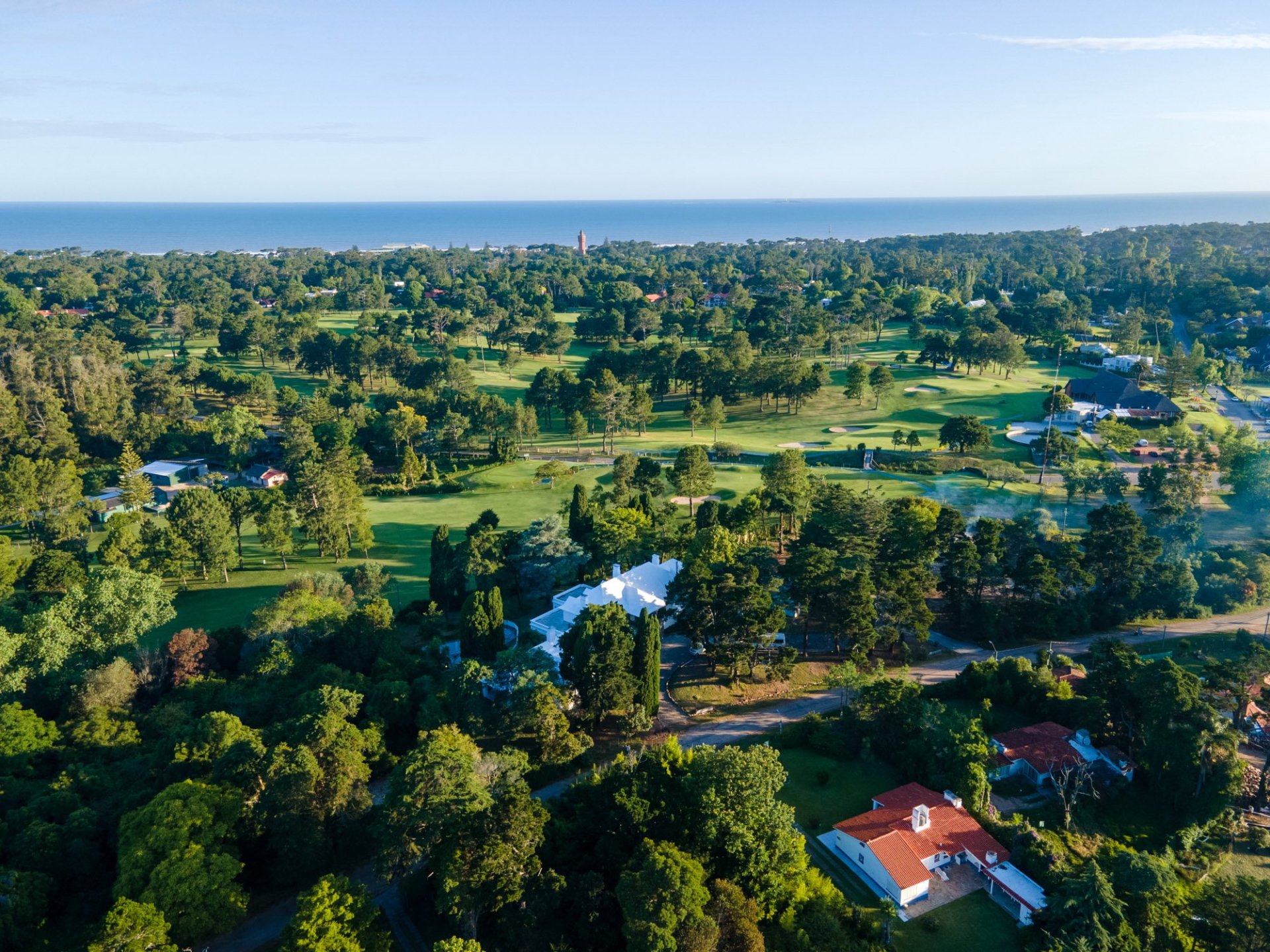
I have been living in Uruguay and working in the real estate sector of Punta del Este for thirteen years. During that time, I have seen cycles, I have seen booms, and I have seen slowdowns. But what is happening today in the Golf neighborhood has no precedent in my professional experience or in the recent history of the eastern market.
The Golf has always been a coveted address. Its tree-lined streets, proximity to the Cantegril Country Club, and unique architecture that few neighborhoods in the country can match have made it the preferred destination for those seeking a luxury second home or deciding to settle permanently in Uruguay for decades. However, for years, a single variable hindered operations, inhibited capital, and generated doubts in investors who would otherwise have bet without hesitation: the Kennedy settlement.
I know this because it happened to me.
About 5 years ago, my husband and I were about to buy a beautiful house located right on the golf course, at a price that at that time was an exceptional opportunity. Everything indicated that it was the right moment to enter. But we didn’t. The Kennedy held us back. The fear of insecurity, the uncertainty generated by the presence of the settlement, weighed more than the logic of the market. We decided to wait.
It was one of the most costly mistakes of my professional and personal life. That house is now worth several times more than it did back then, and I knew this because it was recently sold for a figure that quadruples its value from that time. And that difference is not an abstract number: it is the exact representation of what it means to hesitate when the market is sending clear signals.
I share this because I don’t want that to happen to those who are currently looking at the Golf with interest. Because the window exists, it is open, but it will not be forever. And those who wait for the values to fully reflect the potential of the area will arrive too late.
In my conversations with clients over the years, the Kennedy appeared time and again as the obstacle. It was the elephant in the room of Punta del Este's most exclusive neighborhood. Today, that obstacle has ceased to exist. And what has come after is redefining the real estate market.
The Before and After: The Relocation That Changed Everything
The Kennedy was established in 1961, at the same time that the golf courses of Cantegril were being built. For more than six decades, 530 families lived in that settlement under conditions of extreme vulnerability, without sanitation or regular access to drinking water, in a property that contrasted dramatically with its immediate surroundings.
On October 21, 2024, in the presence of President Luis Lacalle Pou and the mayor of Maldonado, Enrique Antía, the last house was demolished. The National Army actively participated in the process: approximately 300 relocations and more than 9,000 hours of accumulated work. The resettlement, financed with 55 million dollars through the CAF and the Bank of the Oriental Republic of Uruguay, was classified by the Intendancy as the largest resettlement of settlements carried out in the history of the country.
The families were relocated to a new neighborhood two kilometers from the original site, with drinking water, sanitation, electricity, a full-time school, and a polyclinic. A dignified closure for a long and complex story.
The land occupied by the Kennedy, strategically located next to the golf courses and steps away from the Punta del Este Convention Center, was authorized by the Departmental Board to go out to tender. Premium land in one of the most exclusive addresses in South America, available for the first time in over six decades.
The Projects That Confirm the Moment
The market did not wait. Even before the last wall of the Kennedy fell, major capital was already looking at the area.
The most emblematic project is the Cipriani Ocean Resort, Residences & Casino, under construction on the site of the historic Hotel San Rafael. With an estimated investment of 600 million dollars —the largest in the history of Punta del Este— the development includes three residential towers ranging from 30 to 60 floors, projected to become some of the tallest in South America. The design is by the prestigious Uruguayan architect Rafael Viñoly. A casino, convention center, spa, beach club, and restaurants complete an unprecedented complex in the region. The numbers speak for themselves: one of the three penthouses was sold to a European buyer for 17.1 million dollars, and 40% of the units in the first tower were sold before physical construction began in March 2026.
Just a few meters away, Aura reinforces the new profile of the area: an exclusive private neighborhood development over 27 hectares adjacent to the Cantegril Club golf courses, with 151 lots starting from 1,000 square meters, underground infrastructure, cobblestone streets, and a natural environment of forests and lagoons that is, in itself, a selling point.
Two international-scale projects, in the same corridor, at the same time. That doesn’t happen by chance.
The Numbers That Don’t Lie
The square meter facing the sea in Punta del Este already ranges between 4,000 and 6,000 dollars in standard first-line developments. In super-luxury projects, that value climbs to 11,000 dollars per square meter. However, in the Golf neighborhood, prices are still comparatively low compared to the rest of the area. That gap is precisely the opportunity.
When the Cipriani is operational, when Aura is inhabited, and when the lands of the former Kennedy receive their first private developments, the value of the surroundings will have risen steadily and irreversibly. Added to this is the framework that Uruguay offers: tax incentives for foreign investors, legal security, institutional stability, and a dollarized real estate market that has historically protected the assets of those who invested in time.
After thirteen years in this market, I have rarely seen such a clear convergence of factors: released land, world-class anchor projects, and prices that still do not reflect what the area is about to become. In the Golf of Punta del Este, the time to enter is now. And that, in the world of real estate investments, is not a cliché. It is a fact.
Ruta 10 km 160.
Complejo Palmas de La Barra local 02.
CP 20000. La Barra, Maldonado, Uruguay.
Forest or dunes: how to choose a lot in San Antonio de La Pedrera
Compare landscape, exposure, vegetation, and usage before choosing between forest and dunes in San Antonio de La Pedrera, Rocha. Practical g..
Punta del Este vacation rentals 2027: where to stay, when to book
Punta del Este vacation rentals for summer 2027: how the peninsula, La Barra, Manantiales and José Ignacio compare, and when to book your st..
San Antonio de La Pedrera: a forest facing the ocean in Rocha
Discover San Antonio de La Pedrera on the Rocha coast: location, landscape, community, and a selection of lots near La Pedrera...